From Shapes to Systems: Rethinking Design with Topology Optimization
General Information
Date: Monday, March 23rd
Time: 5:30 PM - 8:30 PM
Location: Helix Brewing
Cost: $5 / $10 / $15 for Students / Members / Non-Members (includes pizza and 1 drink)
Flyer: https://drive.google.com/file/d/1U6XwV8hajtrTR7H2OucKv-K3AFHfJKPJ/view
Tickets: https://square.link/u/QMkuowo7
Description: This technical symposium highlights three cutting-edge graduate research projects from San Diego State University covering aerospace structures, experimental aerodynamics, and autonomous space guidance. Join AIAA members, industry professionals, and students for an engaging evening of presentations and discussion.
Featured Presentations:
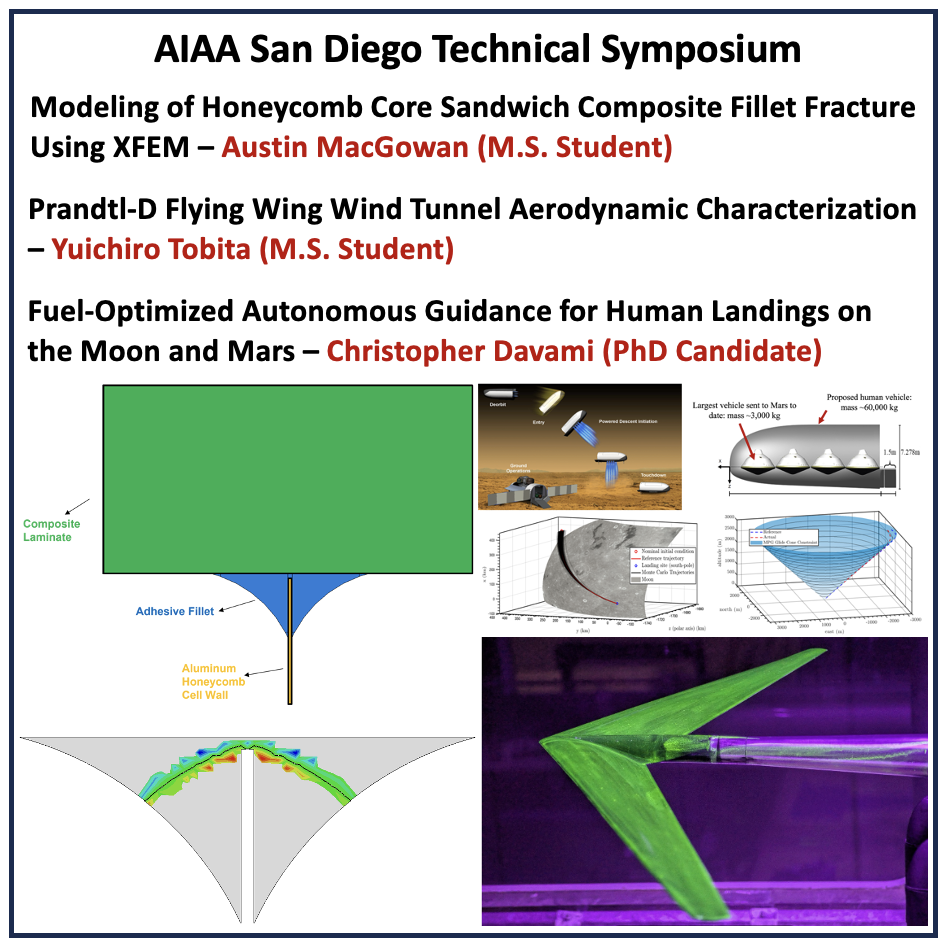
Modeling of Honeycomb Core Sandwich Composite Fillet Fracture Using XFEM – Austin MacGowan (M.S. Student)
Sandwich composites using aluminum honeycomb cores are widely used in aerospace structures due to their high stiffness-to-weight ratio. However, the structural strength of these materials is strongly influenced by fracture behavior in adhesive fillets located between the face-sheets and honeycomb cell walls. Because these fractures occur at extremely small scales, traditional experimental methods cannot fully characterize them.
This research applies to the Extended Finite Element Method (XFEM) within ABAQUS to model crack initiation and propagation within adhesive fillets. By examining how fillet geometry, material properties, and porosity affect fracture behavior, the work aims to improve prediction of interface strength in honeycomb sandwich structures and reduce reliance on costly experimental testing and conservative knockdown factors.
Prandtl-D Flying Wing Wind Tunnel Aerodynamic Characterization – Yuichiro Tobita (M.S. Student)
The Prandtl-D flying wing concept applies Prandtl’s Bell-Shaped Lift Distribution to reduce induced drag and improve aerodynamic efficiency. Wind-tunnel testing conducted at SDSU measured aerodynamic forces and moments while oil-film visualization techniques revealed detailed surface-flow patterns.
Results showed strong agreement with prior computational and experimental studies. Flow visualization identified a spanwise laminar separation bubble at low angles of attack that transitions to full-span separation beyond stall. Complementary computational analysis using the OVERFLOW CFD solver further validated the experimental results, providing insight into the unique aerodynamic behavior of the Prandtl-D configuration.
Fuel-Optimized Autonomous Guidance for Human Landings on the Moon and Mars – Christopher Davami (PhD Candidate)
Future human missions to the Moon and Mars will require landing vehicles far larger and more precise than today’s robotic missions. Early Mars landers may exceed 60,000 kg and must land within tens of meters of target sites while consuming large amounts of propellant during descent.
This research develops computationally efficient onboard guidance algorithms that minimize propellant usage while maintaining landing accuracy and safety. Using optimal control methods designed for flight computers, the approach enables fuel-optimal trajectory generation and real-time tracking control. Simulation results demonstrate a significant reduction in propellant consumption—from approximately 20,000 kg to 8,000 kg—while maintaining precise landing capability for future crewed planetary missions.